
The Celestial Bear Hunt

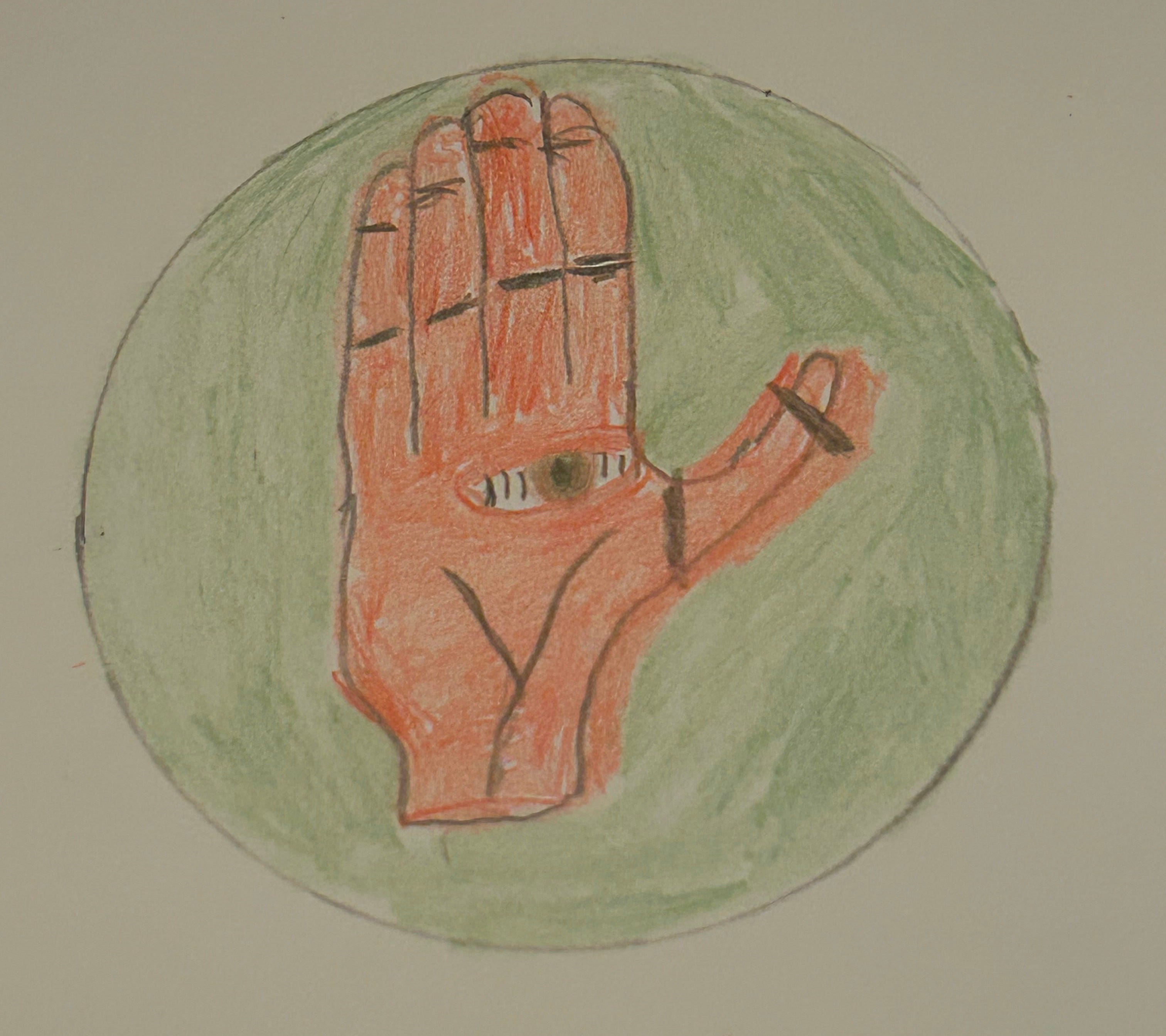
Eye in Hand Mandala by Ray Zimmerman
The Big Dipper is a picture within a picture. It appears in the constellation known as The Great Bear or Ursa Major. Astronomers divide the sky into 88 official constellations. Other star pictures are called asterisms.
Several Native American tribes identified the constellation as a bear and included the celestial bear among their stories. In 1900, Stansbury Hagar published a scholarly paper, “The Celestial Bear Hunt,” in The Journal of American Folklore, Volume 13, Number 49. He discussed the seasonal movement of the dipper, referring to the winter reclining dipper as the bear in the den.
In other tribes’ stories, each star represents a different hunter. Some tribes visualized each hunter as a type of bird.
Another source of bar stories is They Dance in the Sky: Native American Star Myths by Jean Guard Monroe and Ray A. Williamson. This lovely book has sections devoted to the celestial bear stores and stories of the Pleiades. These portions are cross-sectional with stories from various tribes. Other sections are devoted to the star myths of specific tribes. Old Man Coyote makes an appearance.
Bear stories are common throughout the northern hemisphere. Paul Shepard and Barry Sanders collected these stories from multiple cultures in their book The Sacred Paw: The Bear in Nature, Literature, and Myth, with a contribution by Gary Snyder. They included both North American bear stories and the Greek myth of Callisto.
Callisto gave birth to a son fathered by Zeus and named him Arctos, from which our word Arctic is derived. He transformed Callisto into a bear to protect her from her jealous husband, Juno. In another version of the story, Juno turned her into a bear as punishment.
A third version of the story relates that Callisto was a water nymph devoted to Diana, the moon goddess, and that Diana punished her for forsaking her vows, though her actions may not have been voluntary. Callisto’s son, Arctos, also ends up transformed and placed in the sky in most versions.
The book also includes bear stories from the Ainu people, residents of eastern Russia, and various Pacific Islands, including Hokkaido, Japan. I don’t recall that portion mentioning Star Myths, but it has been several years since I read The Sacred Paw.
Escape From Slavery
At the end of the Big Dipper, the two stars point to the North Star. The North Star is a guidepost for navigation, and the Big Dipper inspired the song “Follow the Drinkin’ Gourd.” It was a guide for enslaved people traveling on the underground railway.
Star Gazing Resources
JSTOR has made a downloadable copy of Hagar’s paper available on the website: https://www.jstor.org/stable/pdf/533799.pdf.
They Dance in the Sky https://www.goodreads.com/book/show/1492526.They_Dance_in_the_Sky.
The Sacred Paw: The Bear in Nature, Literature, and Myth https://www.goodreads.com/en/book/show/1150497.The_Sacred_Paw.
Information about the Ainu Culture is also available here: https://en.wikipedia.org/wiki/Ainu_people.
Wikipedia has a detailed description of the Callisto stories available here: https://en.wikipedia.org/wiki/Callisto_(mythology). I include the link because The Sacred Paw is out of print, and copies are difficult to obtain.